Reducing Emissions Is Good. Avoiding them is Better
When discussing sustainable road construction, the focus is often on carbon offsets and compensation mechanisms.
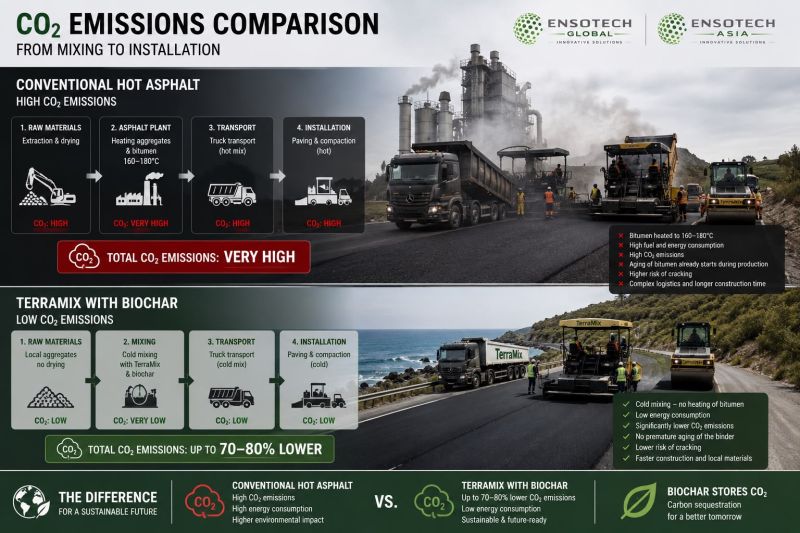
But the first question should be much simpler: How much CO₂ can we avoid before construction even begins? The comparison below highlights one of the fundamental differences between conventional hot-mix asphalt and the TerraMix system approach.
Conventional asphalt typically requires: • drying of aggregates • heating of bitumen to 160–180°C • high energy consumption during production • transport of hot material • complex logistics and time-critical installation
Each of these steps contributes to the overall carbon footprint of the project. TerraMix follows a different approach. Using cold-mix technology, local aggregates and biochar integration, the process eliminates the energy-intensive heating stage and significantly reduces emissions throughout the entire value chain—from mixing to installation.
The result: ✔ Up to 70–80% lower CO₂ emissions ✔ Lower energy demand ✔ Reduced logistics complexity ✔ Local material utilization ✔ Faster construction and traffic release ✔ Additional carbon storage potential through biochar Sustainability is not achieved through a single innovation. It is achieved when every step of the process is challenged and improved. The future of infrastructure will be defined not only by what we build, but by how we build it.
Building Roads. Storing Carbon.
A practical pathway toward climate-positive infrastructure.